» Chronic Conditions » What Are the Differences Between Alzheimer and Dementia?
What Are the Differences Between Alzheimer and Dementia?
February 5, 2026
Many people use the terms Alzheimer and dementia interchangeably, which often leads to confusion. A common question patients and families ask is: what is the difference between Alzheimer and dementia? While they are closely related, they are not the same thing.
Understanding the difference between dementia and Alzheimer can help you recognize symptoms earlier, seek the right care, and make informed decisions about treatment and long-term support. Below, we clearly explain how these conditions differ, how they are connected, and what comes first, dementia or Alzheimer.
What Is the Difference Between Dementia and Alzheimer’s Disease?
The main difference between dementia and Alzheimer’s disease is this:
Dementia is an umbrella term that describes a group of symptoms affecting memory, thinking, behavior, and daily functioning.
Alzheimer’s disease is a specific brain disease and the most common cause of dementia.
In simple terms, Alzheimer’s causes dementia, but not all dementia is caused by Alzheimer’s.
A helpful analogy:
Dementia is like the word fruit
Alzheimer’s is like apples
All apples are fruit, but not all fruit are apples. In the same way, Alzheimer’s is a type of dementia, but dementia can have many different causes.
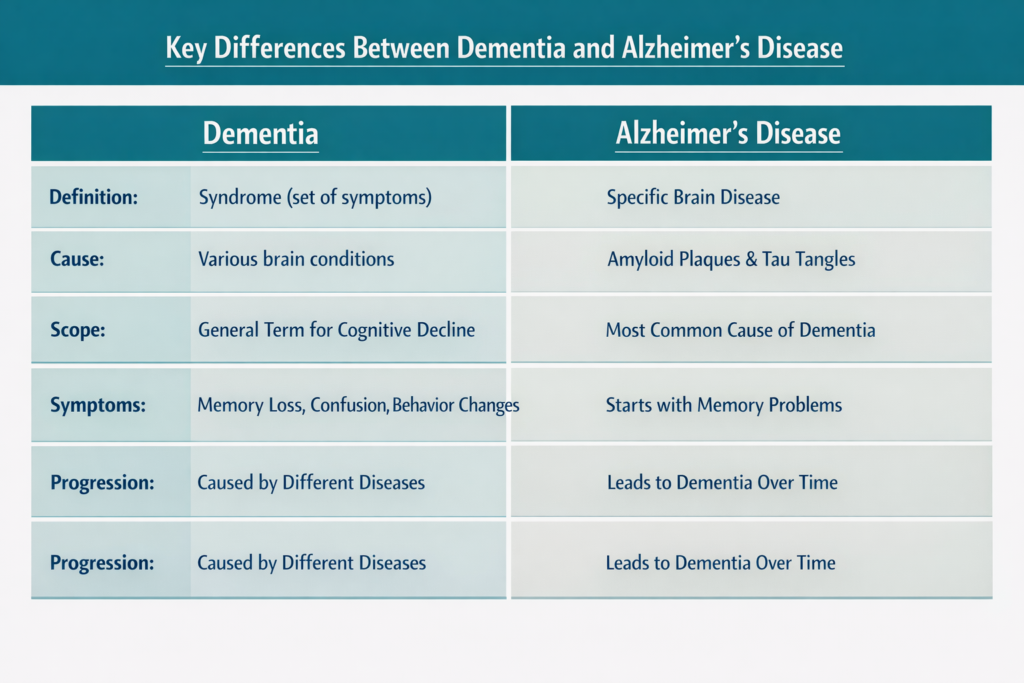
Here is a table that shows the Key Differences between Dementia and Alzheimers
Dementia vs Alzheimer: Understanding the Relationship
Is Alzheimer and Dementia the Same?
No, Alzheimer and dementia are not the same.
Dementia refers to a set of symptoms
Alzheimer’s refers to a specific disease in the brain
Someone can have dementia caused by Alzheimer’s disease, vascular disease, Lewy body disease, or other neurological conditions.
What Is Dementia?
Dementia is a term used to describe a decline in cognitive function that interferes with everyday life. It is caused by damage or disease affecting the brain and is not a normal part of aging.
Common Symptoms of Dementia
Symptoms vary from person to person, but often include:
Memory loss, especially forgetting recent events
Confusion and difficulty making decisions
Problems with problem solving and planning
Trouble following conversations or finding words
Difficulty completing familiar daily tasks
Changes in mood, behavior, or personality
Increased anxiety, irritability, or depression
Not everyone with dementia experiences memory loss early on. In some types, changes in behavior or language may appear first.
Is Dementia Progressive?
Yes. All types of dementia are progressive, meaning symptoms gradually worsen over time. While treatments can help manage symptoms, dementia is currently a life-limiting condition.
Alzheimer’s disease is the most common cause of dementia. It accounts for roughly two out of three dementia cases.
Alzheimer’s is a physical disease of the brain that begins years before noticeable symptoms appear. Early changes happen silently, long before memory loss becomes obvious.
Early Alzheimer’s Symptoms
In the early stages, symptoms are often mild and may include:
Forgetting recent conversations or appointments
Difficulty learning new information
Mild confusion
Trouble concentrating
This stage is often referred to as mild cognitive impairment (MCI). At this point, many people can still manage daily activities independently.
As Alzheimer’s progresses, brain damage becomes more widespread, eventually leading to dementia symptoms that interfere with daily life.
What Comes First: Dementia or Alzheimer?
This is a very common question: what comes first, dementia or Alzheimer?
The answer depends on perspective:
Alzheimer’s disease starts first in the brain, often years before symptoms
Dementia develops later, when cognitive symptoms become severe enough to affect daily functioning
So while Alzheimer’s comes first biologically, dementia is the stage when symptoms are noticeable and impactful.
What Causes Alzheimer’s Disease?
Alzheimer’s disease is linked to complex changes in the brain. One major factor is the buildup of abnormal proteins, including:
Amyloid plaques, which form between brain cells
Tau tangles, which build up inside brain cells
These protein clumps disrupt communication between brain cells, cause inflammation, and eventually lead to cell death. Over time, affected areas of the brain shrink, especially regions involved in memory and learning.
There is currently no cure for Alzheimer’s disease, but treatments may help slow symptom progression and improve quality of life for some people.
Other Common Types of Dementia
Alzheimer’s is the most common cause, but it is not the only one. Other types of dementia include:
Vascular Dementia
Caused by reduced blood flow to the brain
Often linked to stroke or cardiovascular disease
Symptoms may appear suddenly or worsen step by step
Lewy Body Dementia
Caused by abnormal protein deposits called Lewy bodies
Can cause hallucinations, movement problems, and sleep disturbances
There are two main forms:
Dementia with Lewy bodies
Parkinson’s disease dementia
Frontotemporal Dementia
Affects the frontal and temporal lobes of the brain
Often causes early changes in behavior, personality, or language
Mixed Dementia
Occurs when more than one type of dementia is present
Common combinations include Alzheimer’s and vascular dementia
How Is Dementia Diagnosed?
A dementia diagnosis is typically made by a healthcare professional following a detailed evaluation. This may include:
Medical history review
Cognitive and memory testing
Brain imaging
Blood tests to rule out other causes
Identifying the specific type of dementia is not always possible early on, but it can help guide treatment decisions and care planning. To get comprehensive primary care, and to learn more about brain health, become a patient today.
Key Differences Between Dementia and Alzheimer at a Glance
Dementia is a syndrome, not a disease
Alzheimer’s is a specific brain disease
Alzheimer’s is the most common cause of dementia
Dementia describes symptoms, Alzheimer’s describes the cause
Alzheimer’s leads to dementia over time
Does Dementia Turn Into Alzheimer’s?
Dementia does not turn into Alzheimer’s disease. Alzheimer’s is a specific brain disease, while dementia is a term used to describe a group of symptoms caused by different brain conditions. In many cases, Alzheimer’s disease is the underlying cause of dementia symptoms, which is why the two are often confused. However, once someone has dementia, it does not “progress” into Alzheimer’s. Instead, the dementia symptoms worsen over time based on the disease causing them, whether that is Alzheimer’s, vascular dementia, or another condition.
When to Seek Care
If you or a loved one is experiencing memory problems, confusion, or changes in thinking or behavior, early evaluation is important. Primary care providers play a key role in identifying symptoms, coordinating testing, and managing ongoing care.
Understanding what is the difference between dementia and Alzheimer can empower patients and families to seek timely care and support. While Alzheimer’s and dementia are closely connected, they are not the same. Knowing the distinction helps clarify symptoms, treatment options, and expectations for the future.
If you have concerns about memory or cognitive health, early guidance from a trusted primary care provider can make a meaningful difference.
As we age, our feet bear the weight of a lifetime quite literally. Decades of walking, standing, and wearing different types of footwear can lead to various foot conditions. Foot pain and other problems become more common in older adults, often impacting balance, mobility, and quality of life. Understanding the causes, symptoms, and treatments for […]
As we age, our feet bear the weight of a lifetime quite literally. Decades of walking, standing, and wearing different types of footwear can lead to various foot conditions. Foot pain and other problems become more common in older adults, often impacting balance, mobility, and quality of life. Understanding the causes, symptoms, and treatments for […]
Alzheimer’s disease is a progressive brain disorder that affects memory, thinking, and behavior. It doesn’t happen overnight, instead, symptoms develop gradually over several years. Understanding how long the 7 stages of Alzheimer’s last can help families prepare for the journey ahead. In this guide, we’ll walk you through what are the 7 stages of Alzheimer’s […]
Millions of people turn to joint health supplements to ease arthritis pain, improve mobility, and protect joint function. With so many options available from glucosamine to omega-3s, it’s natural to wonder: do joint supplements work? While research shows mixed results, certain supplements may help reduce joint pain and inflammation, especially when paired with medical treatment […]